Sunday, December 15, 2013

Thoroughbred colors part 2

Roan does not exist
*The Catch A Bird Exception: The only exception to the statement that there are no true, dark-headed roan TBs has cropped up very recently. In 1982, a very unusually marked Thoroughbred was born in Australia named Catch A Bird. He looks like a bay horse with white brindling, the opposite of the dark lines seen on "normal" brindles. Stranger still, as a stallion, Catch A Bird has produced four offspring that appear to be true, dark-headed roans, indicating that Catch A Bird carries a one-time genetic mutation that has produced roan. As far as I know, none of the 4 "roan" foals, Odd Colours (1992 mare), Slip Catch (1993 mare), Goldhill Park (1994 horse), and Red Noble (1996 gelding), have been tested to see if they carry the roan gene, but they certainly exhibit the typical roan phenotype. Interestingly, Slip Catch has produced two roan foals, Lavender Fields and Pink Flloyd.Slip Catch and her foals were rescued by Winning Colors Farm in Australia where their rare color is being preserved and promoted. 

Pictured is Catch A Bird, who looks like a brindle, except with white striping instead of dark striping. With regular brindles, the dark stripes are caused by the sooty hairs in the coat being arranged into lines, rather than being randomly scattered. Catch A Bird's color was most likely the result of skewed rabicano caused by a one-time mutation. Because CAB's color was the result of a mutation, it was not hereditable. But because of the close genetic relationship of several white patterns, including rabicano and roan, the mutation manifested itself in the ability to pass on a variation of roan to his offspring which has proved hereritable.

Long story short, true roan is a new mutation in the Thoroughbred gene pool


Slip catch as a foal

Odd Colours as a foal. Notice her dark head and points, typical of a true roan.

Grey
Young
Mid age
Old

Some greys retain odd patches of color known as "bloody shoulder marks" though the marks can occur on the neck, barrel, and elsewhere as well. 


Pictured below (top) is Colorful Tour winning the 2003 Essex Stakes. He is a chestnutrabicano, a pattern that is often confused with true dark-headed roan. The rabicano gene, however, is entirely seperate from the roan gene, though it does create a pattern of white hairs that is similar to roan. It is usually manifested as a sprinkling of white hairs radiating out from the horses flank. Rabicanos also have a white-topped tail, known as a coon tail or skunk tail. Other notable rabicano TBs are Cox's Ridge, his dam Our Martha, and Carrier Pigeon. There is some thought that rabicano may be tied to the sabino gene.


Colorful Tour, exhibiting the rabicano pattern. Note the white hairs on his flank and the top of his tail.


This is Skunktail, a bay rabicano, showing off a bold skunk tail that earned him his name. Not all rabicanos have this much white on their tails. He appears to be a sabino as well.

Thursday, December 12, 2013

Thoroughbred colors


In this post I will cover thoroughbred coat colors. 

Black, chestnut, bay, and brown are all common
Black


Chestnut
Brown
Bay


They also come in palomino, cremello, perlino, buckskin, smokey black, and smokey cream

Palamino
Cremello

Perlino
Buckskin
Smokey black
Smokey cream

Next time we will cover patterns!

Thursday, November 7, 2013

Showtime


She's DONE! Here are the pictures!

She is a dunskin based off of this foal
 But I added a sock and a snip

Thursday, October 31, 2013

Costume!

Started time payments ! Guess who made it ! 


Bella's biopsy results


This is the email I receive from my mom. 


The vet called me today with the results of Bella’s biopsy.  I couldn’t understand the official name of the type of cells that they found, but basically it is a low grade (not aggressive) tumor.  They believe it is a nerve sheath tumor (or possibly connective tissue tumor).  It is not melanoma, but it is not benign either.  It is not common.


She recommends that we use an injectable chemotherapy treatment.  She would need 2-4 treatments, about every 3 weeks.  Another option is to surgically remove it and do chemo, but the surgery would be quite invasive (she said “think small softball size incision/hole” to be sure to get all of it) and it would take a long time to heal.  She prefers to do chemo first, and then later, if needed, do surgery after the tumor is smaller so it would be less invasive.  Also, if we do the surgery, we would have to trailer her to their office – they wouldn’t do that at the barn.


She is planning to give her the first injection of chemo when she comes next Tuesday to remove her stitches.  


Sunday, October 13, 2013

Model show


I found time and did a model horse show yesterday! I got 10 nan cards! Overal reserve in performance, and overal reserve in Peter stone halter.  And that isn't the best part! I bought my first custom! Try to guess what it was! He is a Morgan! I also entered the raffle with $30 in tickets! Lol! It was for an unpainted showtime resin! And everyone at the show wanted her! She is a limited run of 50 and her full price is $250. And only 5 were sold. The rest were given to shows as a donation peice! And I WON! She gets shipped out to Sherry Clayton tomorrow to be painted as a dunskin! I


And the showtime resin!


Tuesday, October 1, 2013

Squamous-cell carcinoma

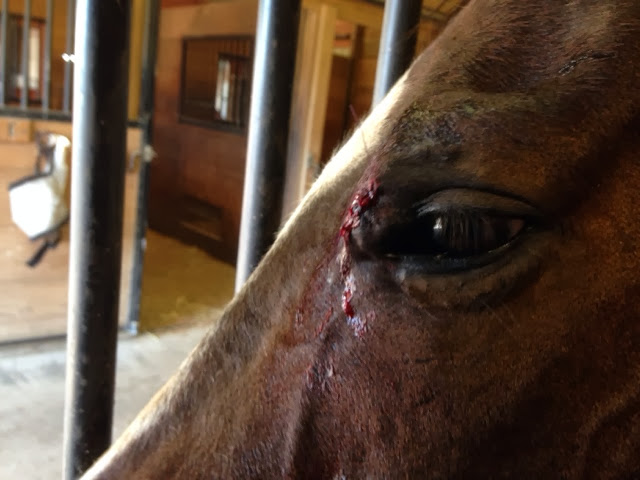
Unfortunately yesterday the vet was out for normal fall shots and teeth. Of course my horse was sore and she checked her feet and while she asked " has her eyelid always been this swollen?" And I say "what swelling?" And she showed me this:   
 
Then she said it felt hard, and I felt it and sure enough it was very hard and fairly large. I was told it was one of two things. Inflammation from the flies or skin cancer.  We opted to have a biopsy to find out what it is. 
So we now wait.  The vet comes back in two weeks to remove the stitches.